

A few hours to decide
The work that should fill those hours is real research: recomputing the stated discount against the actual last close and the volume-weighted averages, reading the latest quarterly for cash and runway, pulling the register, and checking what the broker email left out. In his own words:
“As a wholesale and sophisticated investor in the Australian Stock market, I get presented with a number of opportunities almost every day. The deal arrives in the morning with usually a very short closure window. As a busy professional, it takes time to understand the deals, understand the facts and other research and analysis tasks.”
And the cost of the squeeze, which is the part that matters:
“Since, there are always blind spots, opportunities and margin of error while looking at the deal, it is quite common to overlook the details in a short period of time with a human being involved. The precursor to the investment performance lies in selecting the good opportunities and letting go of the bad ones. The research used to take hours.”
The shape of this problem is not unique to investing. The decision has a deadline, the research that would inform it does not fit inside that deadline, and so the decision gets made on less than it should be. That is the gap worth closing, and it is a narrower brief than “use AI to pick investments.”
What we built
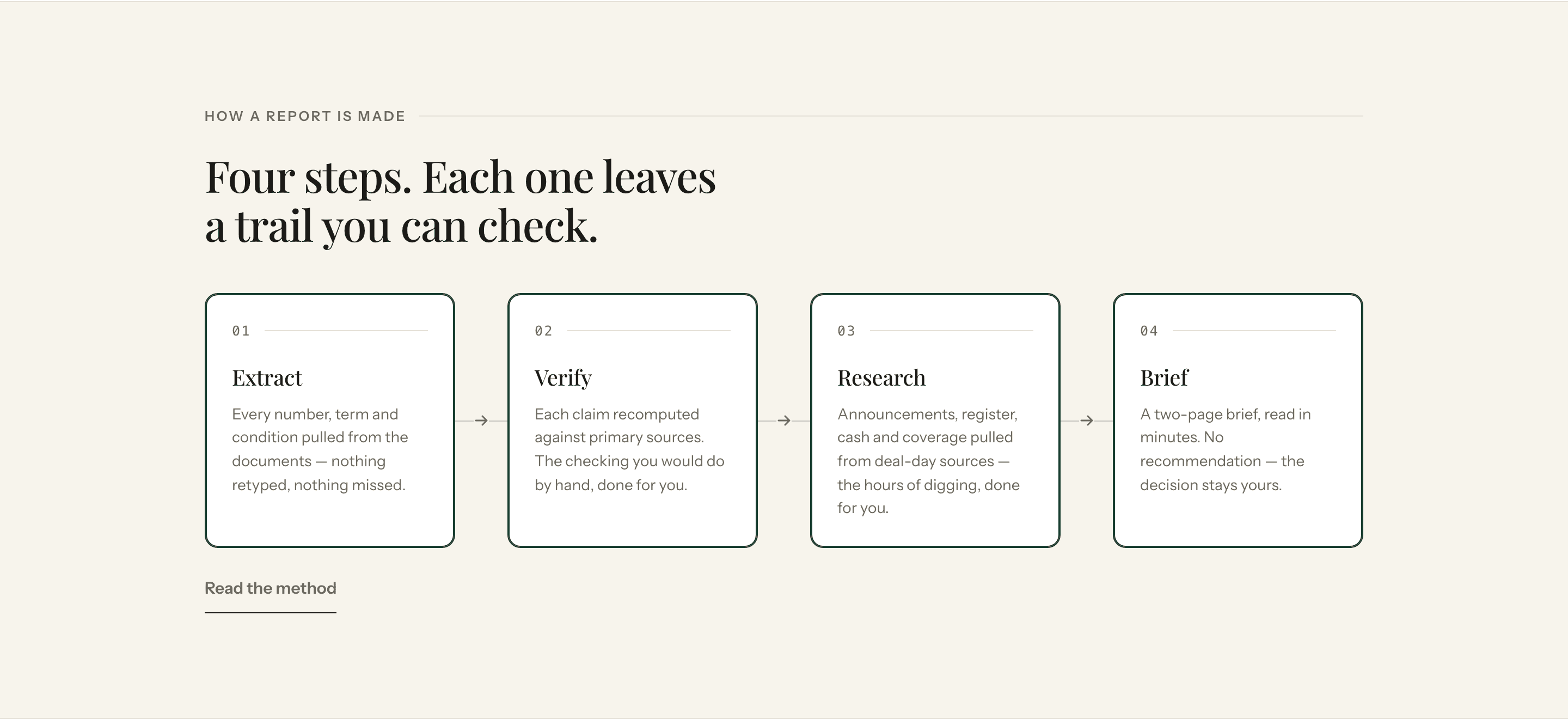
RaiseNote is a research engine with an app in front of it. Four steps, each one leaving a trail that can be checked afterwards.
- Extract. Every number, term and condition pulled from the uploaded documents. Nothing retyped by hand.
- Verify. Each material claim recomputed against primary sources: the stated discount against the actual last close and the averages, cash and runway from the latest quarterly, dilution and option overhang from the register.
- Research. Announcements, register, cash position and analyst coverage, pulled from deal-day sources.
- Brief. Two pages, read in minutes, with the full analysis behind it in the same order.
The decision that shaped everything
The reports do not recommend. No buy or pass, no sizing, not even a rating. That was decided early with the client, and the product is built around it: research and decision support, not financial advice.
The other thing would have been easier to build. A score is simple to generate and simple to demonstrate. It is also the point where a research tool starts making claims it cannot stand behind, and in this market it is a regulated claim besides. So the engine does the reading, the recomputation and the digging, sets out what it found and what it could not verify, ranks the risks, and stops. The judgement stays with the investor, which is where the accountability already sat.
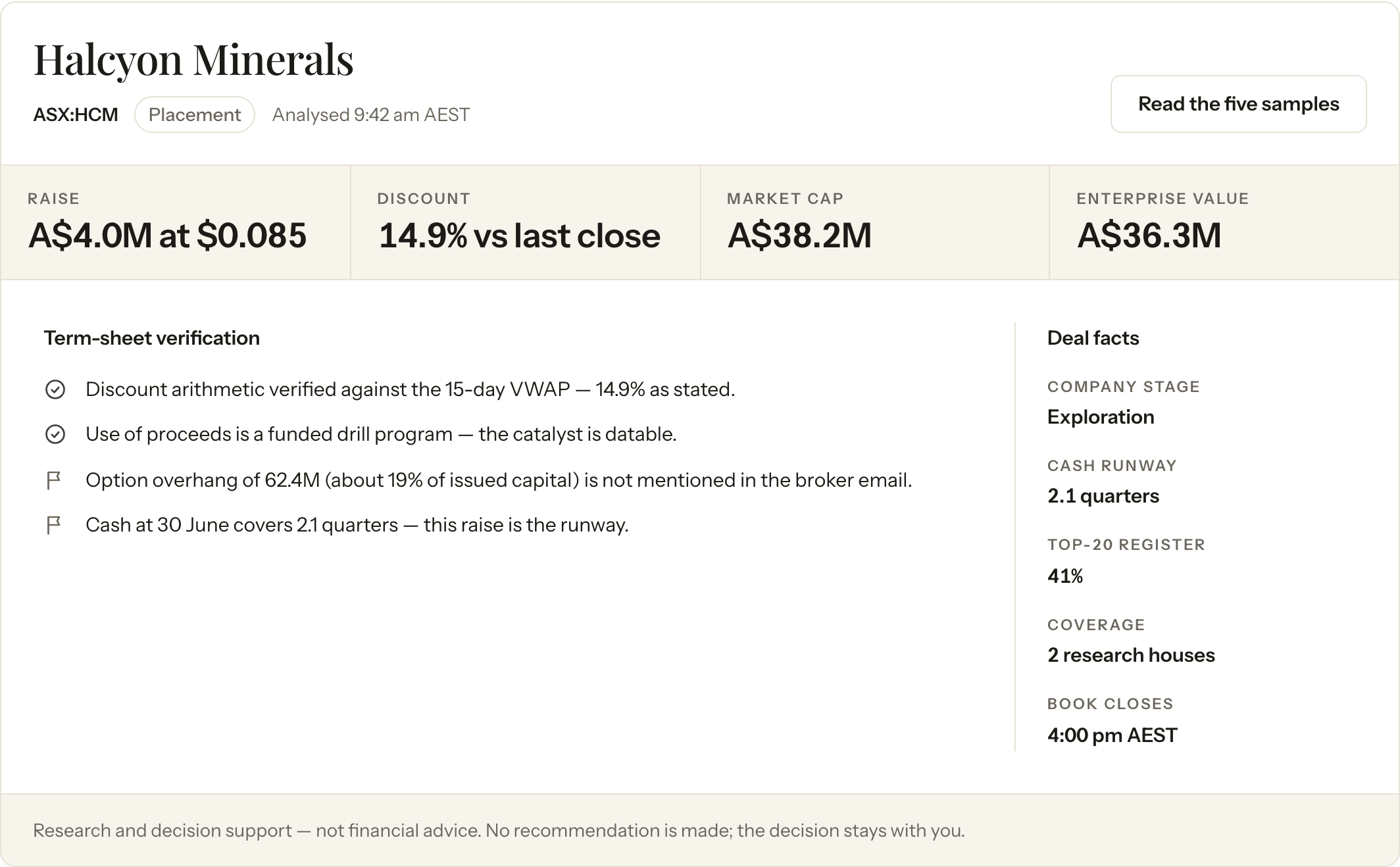
The checks are the point. Some confirm what the documents say, and those are worth knowing too. The ones that earn the brief are the lines the broker email never mentions: an option overhang sitting behind the share count, or a cash position that makes this raise the runway rather than the growth. In the published sample below, two of the four verification lines are items the email left out. Finding those by hand is exactly the work that does not fit in the morning.
What surprised him
“What surprised me the most is the speed and scalability of the whole engine to process the large data and present the information in a meaningful way.”
Working with us
“The approach is quite methodical, as a large consulting company engages and delivers. The documents were as professional as it can be.”
Abhishek Saraf, Director, Ikigai Consortium
See it yourself
RaiseNote is live, with five sample analyses you can read without an account.
raisenote.com.au